
The decision to replace missing teeth involves understanding your options and what each one means for your long-term oral health. Dental implants, dentures, and bridges each offer distinct advantages depending on your specific situation. Dental implants provide a permanent, bone-preserving solution, while dentures work well for more extensive tooth loss, and bridges offer a stable fixed option when fewer teeth are missing. Knowing the differences is the first step toward making a confident, informed choice.
Why Replacing Missing Teeth Matters
Replacing missing teeth is essential for maintaining oral health. Gaps left by missing teeth can lead to shifting, bone loss, and an increased risk of periodontal disease. Beyond the physical effects, missing teeth can also take a real toll on confidence and day-to-day life. Addressing those gaps with the right solution matters for both your health and your well-being.
How Missing Teeth Affect Your Oral Health Over Time
When a tooth is lost and not replaced, the surrounding teeth begin to shift toward the space. Over time, this leads to misalignment, bite problems, and an increased risk of gum disease. Bone loss in the jaw is also a significant concern, as the jawbone depends on the stimulation of tooth roots to maintain its density. The longer a gap is left untreated, the more complex the restoration can become. Timely tooth replacement is one of the most important steps a patient can take to protect their long-term oral health.
The Impact on Your Confidence and Quality of Life
Missing teeth affect far more than just how a smile looks. Many patients experience anxiety in social settings, pull back from conversations, or avoid smiling in photos. The ability to eat comfortably and speak clearly can also be affected. Solutions like dental bridges, dentures, and implants at North Austin Dentistry do more than restore function. They help patients feel like themselves again, allowing them to engage fully in their personal and professional lives without self-consciousness.
What Are Dental Bridges
A dental bridge is a fixed restoration that replaces one or more missing teeth by anchoring artificial teeth to the natural teeth on either side of the gap. Bridges restore both function and appearance without surgery, making them a popular choice for patients who are not candidates for implants or prefer a less invasive approach.
How a Dental Bridge Works
A dental bridge uses the teeth on either side of a gap, called abutment teeth, as support. These neighboring teeth are reshaped to accommodate dental crowns, which anchor the bridge in place. Between those crowns sits an artificial tooth, called a pontic, that fills the gap. An impression is taken to create a precise fit, and a temporary bridge is often placed while the permanent one is being made. Once ready, the bridge is permanently bonded in place, restoring chewing ability, speech, and smile aesthetics.
Materials Used for Dental Bridges at North Austin Dentistry
North Austin Dentistry uses high-quality materials to craft bridges that are both durable and natural-looking. Options include porcelain, which closely matches the color and appearance of natural teeth, metal alloys valued for their strength, and porcelain-fused-to-metal bridges that combine the aesthetic appeal of porcelain with the reliability of a metal base. The right material depends on the location of the bridge in the mouth, the patient’s bite, and personal preference. Dr. Miller will walk you through the best option for your specific situation.
Pros and Cons of Dental Bridges
Dental bridges offer several advantages. They are less invasive than implants, typically require fewer appointments, and do a good job of restoring aesthetics and chewing function. They also help prevent neighboring teeth from shifting into the gap.
On the other hand, bridges do require reshaping the adjacent teeth, which affects healthy tooth structure. They also do not stimulate the jawbone the way an implant does, which means some bone loss may continue beneath the pontic over time. With proper care, a bridge is a reliable and effective solution, but it is worth understanding these trade-offs before committing.
How Long Do Dental Bridges Last
With good oral hygiene and regular dental visits, dental bridges typically last between 5 and 15 years. The lifespan depends on the materials used, the location of the bridge, and how well it is maintained. Brushing, flossing with a floss threader or water flosser, and attending routine checkups all play a role in keeping a bridge in good shape for as long as possible.
What Are Dentures
Dentures are removable appliances designed to replace missing teeth and restore function and appearance. They are one of the most widely used tooth replacement options and have improved significantly in comfort and realism over the years. Whether a patient has lost all their teeth or just some, there is a denture option designed to help.
Full Dentures vs. Partial Dentures
Full dentures replace an entire arch of teeth, upper or lower, and rest directly on the gums. They are custom-made to fit the contours of each patient’s mouth and can be a great solution when all teeth in an arch are missing or need to be removed.
Partial dentures, on the other hand, are used when some natural teeth remain. They fill in the gaps left by missing teeth and attach to the surrounding natural teeth using clasps or precision attachments. Partial dentures also help prevent remaining teeth from shifting and support the overall structure of the mouth.
What to Expect Living With Dentures
Adjusting to dentures takes time, and that is completely normal. In the early weeks, patients may experience mild soreness as the gums adapt, and speaking or eating may feel different than before. With practice, most patients adjust well and find their dentures comfortable and functional. Dentures need to be removed at night, cleaned daily, and kept moist when not in use. Periodic adjustments may also be needed as the gums and jawbone change shape over time.
Pros and Cons of Dentures
Dentures are one of the most accessible tooth replacement options available. They do not require surgery, can replace a large number of missing teeth at once, and can significantly improve both appearance and function. For patients who are not candidates for implants or bridges, dentures are often the most practical path forward.
The main challenges with dentures include the potential for slipping or discomfort, especially as the jawbone changes over time. They require daily maintenance and may need to be refitted or replaced as the mouth changes. Some patients also notice a reduced ability to taste food while wearing full dentures. These are important factors to weigh during the decision-making process.
How Long Do Dentures Last
Dentures generally last between 5 and 10 years before they need to be replaced or significantly adjusted. Changes in the jawbone and gum tissue over time can cause a once-comfortable fit to become loose or uncomfortable. Routine dental visits allow Dr. Miller to monitor the fit and condition of dentures and recommend adjustments before small issues become bigger problems. Good daily cleaning habits also extend the life of the appliance.

What Are Dental Implants
Dental implants are the most advanced and longest-lasting tooth replacement option available today. They replace the root of a missing tooth with a titanium post that is surgically placed into the jawbone, which then fuses with the bone over time to create a stable, permanent foundation. A custom crown is attached on top, giving patients a result that looks, feels, and functions like a natural tooth.
How the Dental Implant Process Works
The implant process begins with a thorough evaluation, including X-rays and imaging to assess bone density and overall oral health. If a patient is a good candidate, the titanium implant is surgically placed into the jawbone. A healing period of several months follows, during which the implant fuses with the surrounding bone in a process called osseointegration. Once healed, an abutment is attached to the implant, and a custom crown is placed on top to complete the restoration. While the process takes time, the result is a stable, natural-looking tooth that does not require any special maintenance beyond regular brushing and flossing.
Types of Dental Implants Offered at North Austin Dentistry
North Austin Dentistry offers several implant options to meet a range of patient needs. Endosteal implants are the most common type and are placed directly into the jawbone to support a single crown, a bridge, or a full arch of teeth. Subperiosteal implants rest beneath the gum tissue but above the jawbone and are used for patients who do not have enough bone density for traditional implants. For patients with significant bone loss, zygomatic implants anchored in the cheekbone may be an option. Dr. Miller will evaluate your specific situation and recommend the most appropriate type for your needs.
Pros and Cons of Dental Implants
Dental implants come with a long list of benefits. They look and feel completely natural, preserve jawbone density, do not affect neighboring teeth, and are designed to last for decades with proper care. They are also the only tooth replacement option that stimulates the jawbone the way a natural tooth root does, which helps prevent the bone loss that typically follows tooth extraction.
The main considerations with implants are the time commitment and the surgical nature of the procedure. The full process can take several months from placement to final restoration, and not every patient qualifies based on bone density or overall health. Implants also tend to carry a higher upfront investment than other options, though their long lifespan often makes them the most cost-effective choice over time.
How Long Do Dental Implants Last
Dental implants are built to last. With proper oral hygiene and regular dental visits, implants can last 15 years or more, and many patients keep them for a lifetime. The crown attached to the implant may need to be replaced after 10 to 15 years due to normal wear, but the implant itself typically remains stable and intact. This durability sets implants apart from both bridges and dentures when it comes to long-term value.
Dental Implants vs. Dentures vs. Bridges Side by Side
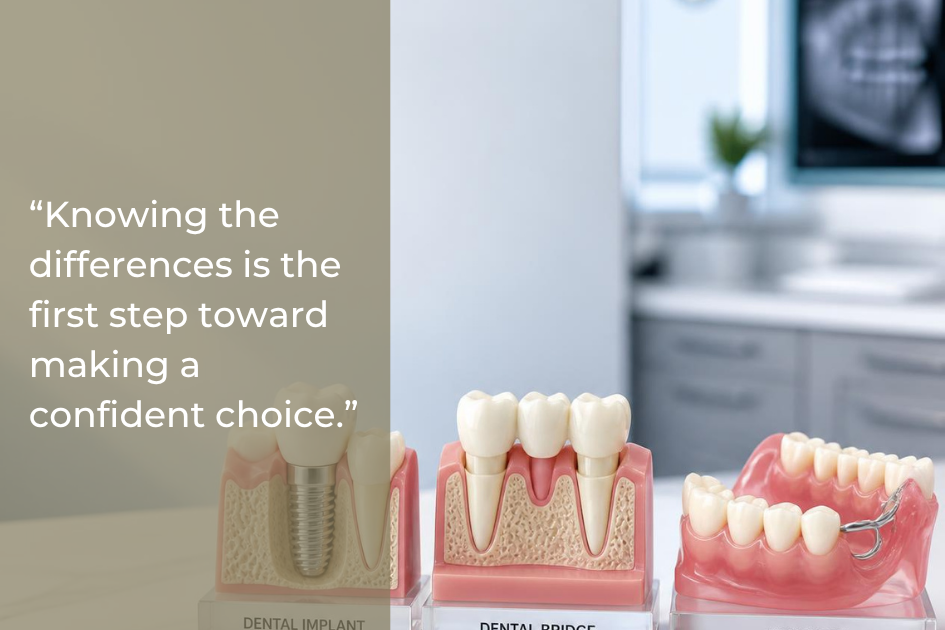
Choosing between implants, dentures, and bridges comes down to a few key factors: how long the restoration will last, how comfortable it is to live with, how it affects the jawbone, and whether a patient qualifies for it. Here is how the three options compare across each of these areas.
Comparing Durability and Longevity
Dental implants are the clear winner when it comes to longevity. With proper care, they can last a lifetime. Bridges typically last 5 to 15 years, depending on oral hygiene and the materials used. Dentures generally need to be replaced or refitted every 5 to 10 years as the jaw and gum tissue change. For patients who want a solution they will not have to think about replacing, implants offer the most long-term stability.
Comparing Comfort and Daily Function
Implants feel the most like natural teeth. Because they are anchored in the jawbone, they do not shift during eating or speaking and require no special cleaning routine beyond brushing and flossing. Bridges are also fixed and stable, though patients need to floss carefully around and beneath them. Dentures can sometimes feel bulky or shift during use, and they require removal for cleaning each night. Most patients find that comfort improves with all three options over time, but implants tend to require the least adjustment period.
Comparing Jawbone Health
This is one of the most important distinctions between the three options. Dental implants are the only restoration that actively stimulates the jawbone, which helps maintain bone density and prevent the facial changes that can occur after tooth loss. Bridges restore function above the gumline but do not engage the bone beneath, allowing some bone loss to continue. Dentures rest on the gums and provide no bone stimulation at all, which is why patients with long-term denture use may notice changes in facial structure over time. For patients concerned about preserving their jawbone, implants offer a clear advantage.
Comparing Candidacy Requirements
Not every option is right for every patient, and candidacy depends on several individual factors. Dental implants require sufficient bone density, healthy gums, and a commitment to good oral hygiene. Patients with uncontrolled systemic conditions may need to be assessed on a case-by-case basis. Bridges are a good fit for patients with healthy teeth on either side of the gap that can serve as anchors, along with adequate gum health. Dentures have the broadest candidacy range and can be used even in cases of significant bone loss or when multiple teeth across the arch are missing. Dr. Miller will assess your oral health during your consultation and help you understand which options are available to you.
How to Know Which Option Is Right for You
Every patient’s situation is different, and the best tooth replacement option depends on the number of teeth missing, the health of the surrounding teeth and bone, lifestyle preferences, and long-term goals. Here is a general guide to help you think through which option might be the right fit.
You May Be a Good Candidate for a Bridge If
A dental bridge may be a good fit if you are missing one tooth or a few teeth in a row and have healthy, strong teeth on either side of the gap to serve as anchors. Good candidates also have a solid commitment to oral hygiene and no significant bone loss in the area. Bridges are a great option for patients who want a fixed, non-removable restoration without the surgical process involved in getting an implant.
You May Be a Good Candidate for Dentures If
Dentures may be the right choice if you are missing most or all of your teeth, or if extensive bone loss or other health factors make implants or bridges less practical. They are also worth considering for patients looking for a non-surgical solution that can restore function and appearance relatively quickly. Partial dentures work well when some natural teeth remain and can anchor the appliance for additional stability.
You May Be a Good Candidate for Dental Implants If
Dental implants are a strong option if you have healthy gums, adequate bone density in the jaw, and are looking for the most permanent and natural-feeling solution available. Good candidates are committed to oral hygiene and attend regular dental visits. Implants are particularly well-suited for patients who want to avoid impacting neighboring teeth, preserve jawbone health, and invest in a solution they will not have to replace.
Why Austin Patients Choose North Austin Dentistry for Tooth Replacement
Patients across Austin and the surrounding communities come to North Austin Dentistry because they know they will be heard, evaluated thoroughly, and given honest recommendations. Dr. Logan Miller takes the time to understand each patient’s unique situation before making any treatment recommendations, and his team is known for making patients feel at ease from the first visit.
Personalized Treatment Plans With Dr. Logan Miller
No two patients are alike, and Dr. Miller’s approach reflects that. Every tooth replacement consultation at North Austin Dentistry begins with a full assessment of the patient’s oral health, bone structure, and personal goals. From there, Dr. Miller presents realistic options, well-suited to the patient’s needs, and explained clearly so patients can make informed decisions with confidence. Advanced diagnostic technology supports precise planning and predictable outcomes at every stage of treatment.
Multiple Tooth Replacement Solutions Under One Roof
One of the biggest advantages of choosing North Austin Dentistry is the ability to explore all three tooth replacement options, dental implants, dentures, and bridges, with the same trusted provider. Patients do not need to be referred elsewhere or navigate multiple practices to find the right solution. Everything from the initial consultation to the final restoration is handled in-house by a team that knows each patient and their history. That continuity makes the entire process smoother, less stressful, and more effective.
Take the First Step Toward Restoring Your Smile
If you are living with missing teeth, the right solution is closer than you think. Whether dental implants, dentures, or a bridge turns out to be the best fit for your situation, the most important step is scheduling a consultation so Dr. Miller can assess your oral health and walk you through your options. North Austin Dentistry is committed to helping Austin patients restore their smiles in a way that works for their lives, their health, and their long-term goals.